

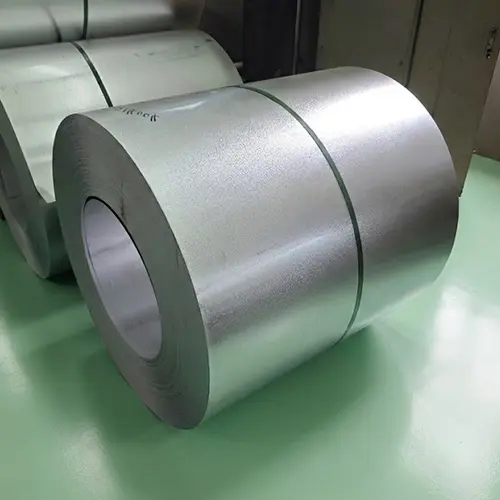
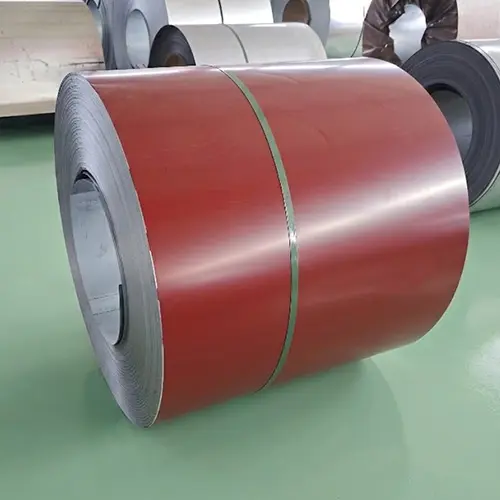

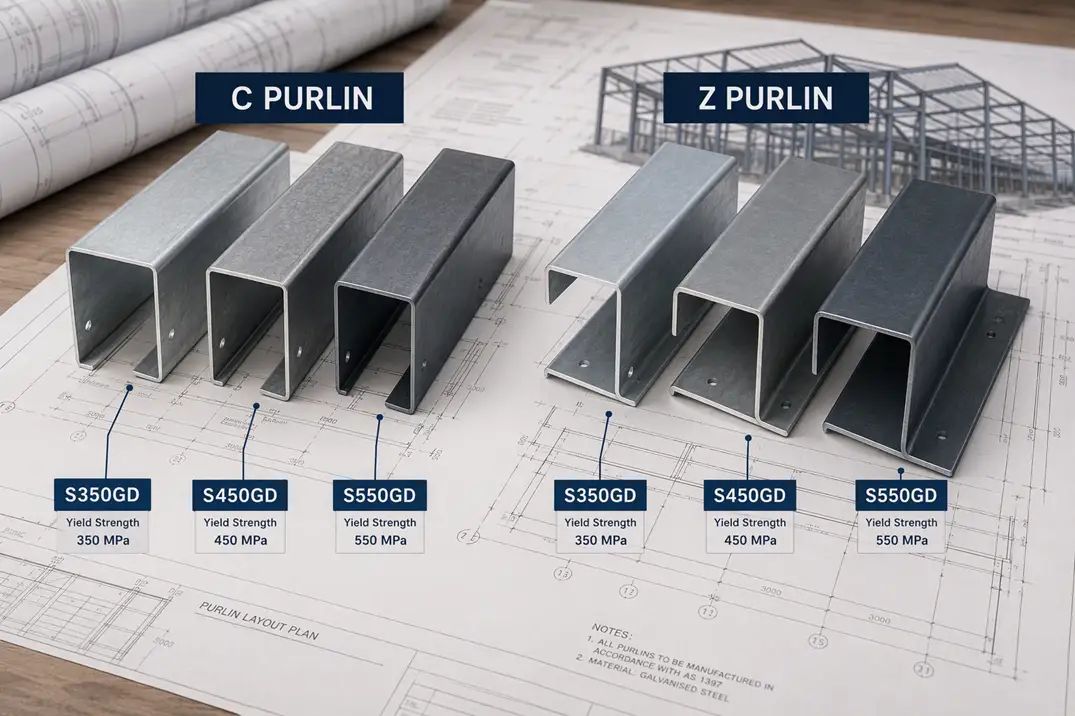
Key Highlights
- S350GD, S450GD, and S550GD mainly differ in minimum yield strength and related mechanical properties.
- For purlins, the chosen steel grade affects forming behavior, section efficiency, and finished profile control.
- A higher structural steel grade can support stronger designs, but it may also increase springback during processing.
- Corrosion resistance depends more on the zinc coating system than on the grade number alone. Buyers should review the MTC because actual coil values can vary above the stated minimums. When choosing between S350GD, S450GD, or S550GD for purlin applications, the best option depends on your structural requirements: S350GD offers sufficient strength for most uses, S450GD provides higher yield strength, and S550GD is suitable for heavy loads. However, for long-term durability, prioritize corrosion resistance and the quality of the zinc coating over simply selecting a higher grade.
- Buyers should review the MTC because actual coil values can vary above the stated minimums.
- The best option matches design, manufacturing, and cost targets together.
Introduction
A C/Z purlin manufacturer may receive three offers for galvanized steel sheet: S350GD, S450GD, and S550GD. Since S550GD has the highest strength level, is it always the best steel grade? Not necessarily. In purlin production, the choice affects structural steel performance, possible thickness optimization, springback, punching behavior, roll forming, and profile accuracy. That is why smart selection starts with the end use and the production line, not just the highest number on the offer.
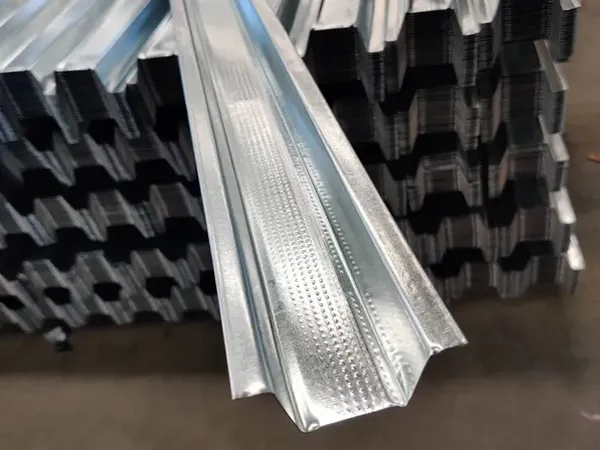
Understanding S350GD, S450GD, and S550GD Steel Grades for Purlins
Start with the code itself. “S” refers to structural grade steel for load-bearing use. The numbers 350, 450, and 550 indicate the minimum yield strength class in MPa. “GD” is the designation used for continuously hot-dip coated structural steel sheet and steel coil.
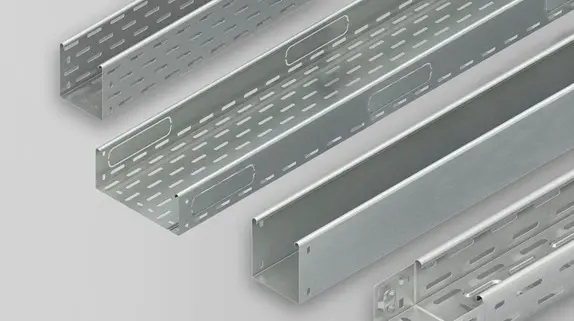
So, which is better for purlin applications? There is no universal winner. S350GD for purlins offers a strong forming balance, S450GD for purlins adds higher strength, and S550GD for purlins serves high-strength construction applications when the design and equipment support it.
Key Properties and Standards of S350GD, S450GD, and S550GD
These galvanized structural steel grades are commonly linked with the European Standard EN 10346 for continuously hot-dip coated steel products. In this system, S350GD is listed with material number 1.0529. For purlin buyers, the key point is simple: grade names define minimum mechanical properties, not one fixed test result for every coil.
Here is a clear text table for comparison:
| Grade | Minimum Yield Strength | Minimum Tensile Strength | General Characteristic |
|---|---|---|---|
| S350GD | 350 MPa | 420 MPa | Strength and good forming balance |
| S450GD | 450 MPa | 510 MPa | Higher strength |
| S550GD | 550 MPa | 560 MPa | High-strength structural grade |
One caution matters. These values are minimums. A delivered steel sheet or steel coil may test above them, so buyers should always check the MTC and the actual mechanical properties before confirming purlin production settings.
Mechanical Differences and Yield Strength Impact on Structural Design
The most direct difference is yield strength. S350GD starts at 350 MPa, S450GD at 450 MPa, and S550GD at 550 MPa. Tensile strength also rises across the grades. These characteristic values influence how a purlin resists load and how a designer may approach section capacity.
In practice, higher strength can support material optimization when structural engineering permits. Yet that does not mean every project should move to the highest grade. A lower-strength option may still be the right fit if the section design, spacing, or profile geometry already meets the required performance.
There is also a manufacturing side. As strength increases, forming response changes. Springback can become more critical, and the relation between Rp0.2 and terms such as upper yield strength ReH should be understood when reviewing test data and setting production expectations.
Application Considerations for C and Z Purlins in Chile
In Chile, construction companies choosing a steel grade for C purlin or steel grade for Z purlin should look at application scenarios, expected stress conditions, and the production route. The right answer depends on the load case and the profile being manufactured, not only on the quoted ton price.
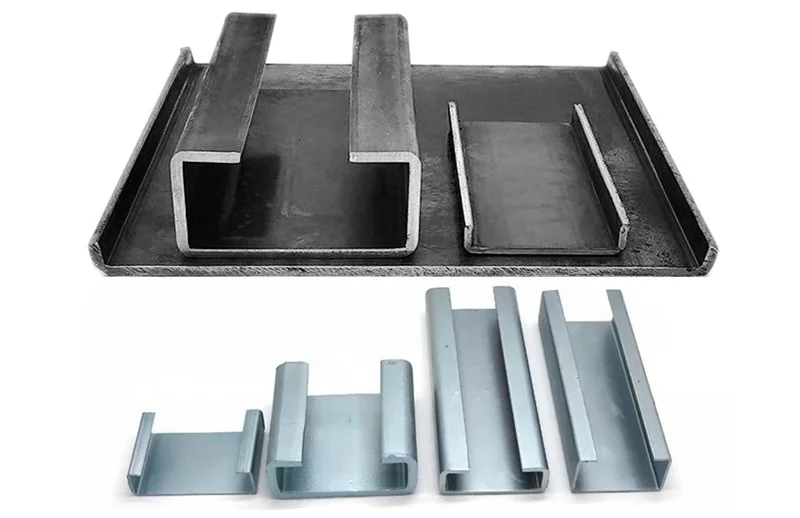
For many standard jobs, S350GD may suit conventional profiles well. S450GD can be evaluated when higher strength is needed with practical processing. S550GD fits high-strength purlin systems when structural engineering requires that level and the line can control forming behavior.
Matching Steel Grade with Manufacturing Techniques and Profile Accuracy
On the factory floor, grade selection changes more than strength. It affects manufacturing techniques, machine setup, and final profile accuracy. S350GD is often valued for good formability and lower springback. S450GD sits in the middle and may work well for lines that need more strength without moving fully into the highest range. S550GD galvanized steel can support light, high-strength sections, but it usually needs tighter process control.
A buyer or production manager should check several points before switching grades:
- springback and dimensional control
- roll pressure, tool setup, and forming radius
- punching, cutting, and line load
- precise adaptation between profile design and base material
So, can S450GD replace S350GD or S550GD directly? Not automatically. Even when the section looks similar, mechanical properties and processing response can differ enough that validation is still necessary before full production.
Conclusion
In conclusion, choosing the right steel grade for C and Z purlins is critical for achieving optimal performance and cost efficiency. The differences among S350GD, S450GD, and S550GD in terms of yield strength, forming behavior, and application suitability highlight the importance of matching the material to your specific structural design and manufacturing processes. Each grade offers unique advantages that can impact the overall effectiveness of your project. By carefully evaluating these factors, you ensure that your choice not only meets the technical requirements but also aligns with your budgetary constraints. If you’re ready to make an informed decision, get quotes today to explore the best options for your needs!
Frequently Asked Questions
Are there notable cost differences among S350GD, S450GD, and S550GD for purlin manufacturing?
Yes, cost differences can exist among these structural steel grades, but buyers should not judge only by steel coil price per ton. A competitive price must be weighed against forming efficiency, profile accuracy, and whether the grade helps optimize the finished purlin in actual production.
Can S450GD be used interchangeably with S350GD or S550GD in structural design?
Not as a simple one-for-one swap. S450GD is a different structural grade with different mechanical properties, so the base material should be reviewed through design and factory validation. Even with excellent dimensional stability, substitution still depends on section capacity and roll-forming response.
How does the corrosion resistance of S350GD, S450GD, and S550GD compare for galvanized purlins?
For galvanized purlins, corrosion resistance depends mainly on the zinc coating or other hot-dip coating system, not only on whether the steel is S350GD, S450GD, or S550GD. In other words, corrosion protection for these steel products is driven more by coating selection and service environment than grade number.